
Quick Summary
A bariatric vitamin bundle is a set of supplements packaged to work together, usually a bariatric multivitamin plus targeted products for nutrients that are hard to absorb after surgery. Bariatric patients often need lifelong supplements because surgery reduces food intake and changes how nutrients are absorbed, and GLP-1 medications can also lower appetite.
- Bariatric surgery reduces food intake and changes nutrient absorption, so supplements are often needed for life.
- Core nutrients to discuss with your provider include a multivitamin, iron, vitamin B12, vitamin D3, calcium citrate, and thiamine.
- Bariatric formulas favor absorbable forms such as calcium citrate, iron bisglycinate, and methylcobalamin.
- Check serving size, nutrient amounts, forms, and procedure-specific design on each label before choosing a bundle.
- Spread supplements across the day and keep iron and calcium separated, as your care team advises.
Table of Contents
- Why Bariatric Patients Need Lifelong Vitamin and Mineral Supplements
- How Surgery and GLP-1 Medications Change Nutrient Absorption
- Gastric Bypass Vitamins List: The Core Nutrients to Cover
- Best Vitamins for Gastric Sleeve Patients and How They Differ
- Bariatric Vitamins vs. Regular Vitamins: Why the Formula Matters
- Liquid, Chewable, and Capsule Forms for Sensitive Stomachs
- Building a Daily Routine With a Bariatric Vitamin Bundle
- Start Your Bariatric Vitamin Plan With Dr. V's Bundle
- Frequently Asked Questions
How to Choose a Bariatric Vitamin Bundle for Daily Health
Last Updated: November 6, 2026
Most people who have weight loss surgery are told they need to take vitamins for life, but few are told exactly what to look for. Nutrient needs after bariatric surgery and on GLP-1 medication are well documented, and this guide explains how to think about them. This guide explains why a bariatric vitamin bundle can help you cover those needs daily, and how to judge whether one fits your situation.
A vitamin bundle is a set of supplements packaged to work together, usually a bariatric multivitamin plus targeted products for nutrients that are hard to absorb after surgery.
Why Bariatric Patients Need Lifelong Vitamin and Mineral Supplements
Bariatric surgery, including gastric bypass and gastric sleeve procedures, reduces how much food you can eat and changes how your body absorbs nutrients (Bariatric surgery and long-term nutritional issues). Many patients take supplements for the rest of their lives to prevent nutrient deficiency and malnutrition.
Key reasons supplementation matters after surgery:
- Less food intake means fewer vitamins and minerals from meals.
- Changed digestion can reduce absorption of iron, calcium, and fat-soluble vitamins.
- Ongoing needs do not stop once you reach your goal weight.
How Surgery and GLP-1 Medications Change Nutrient Absorption
Surgery alters the stomach and sometimes the first part of the small intestine, where many nutrients are absorbed. GLP-1 medications can also lower appetite and food intake, which makes it harder to meet daily nutritional requirements through diet alone.
Common effects to watch for:
- Low iron, which can cause fatigue and weakness
- Low vitamin B12, which affects energy and nerve health
- Low calcium and vitamin D, which affect bone health
- Low thiamine, which matters after reduced eating or vomiting
Some people also notice stomach sensitivity, so the form of a supplement matters as much as the nutrients in it.
Gastric Bypass Vitamins List: The Core Nutrients to Cover
A complete routine for gastric bypass patients usually includes a bariatric multivitamin, iron, vitamin B12, vitamin D, and calcium. Your care team may recommend other nutrients based on lab results.
Core nutrients to discuss with your provider:
- Multivitamin: a daily base that covers many micronutrients
- Iron: often needed in a well-absorbed form
- Vitamin B12: frequently taken as a chewable or sublingual form
- Vitamin D3: supports bone and muscle health
- Calcium citrate: absorbs better than calcium carbonate in reduced-acid stomachs
- Thiamine: a B vitamin involved in energy metabolism
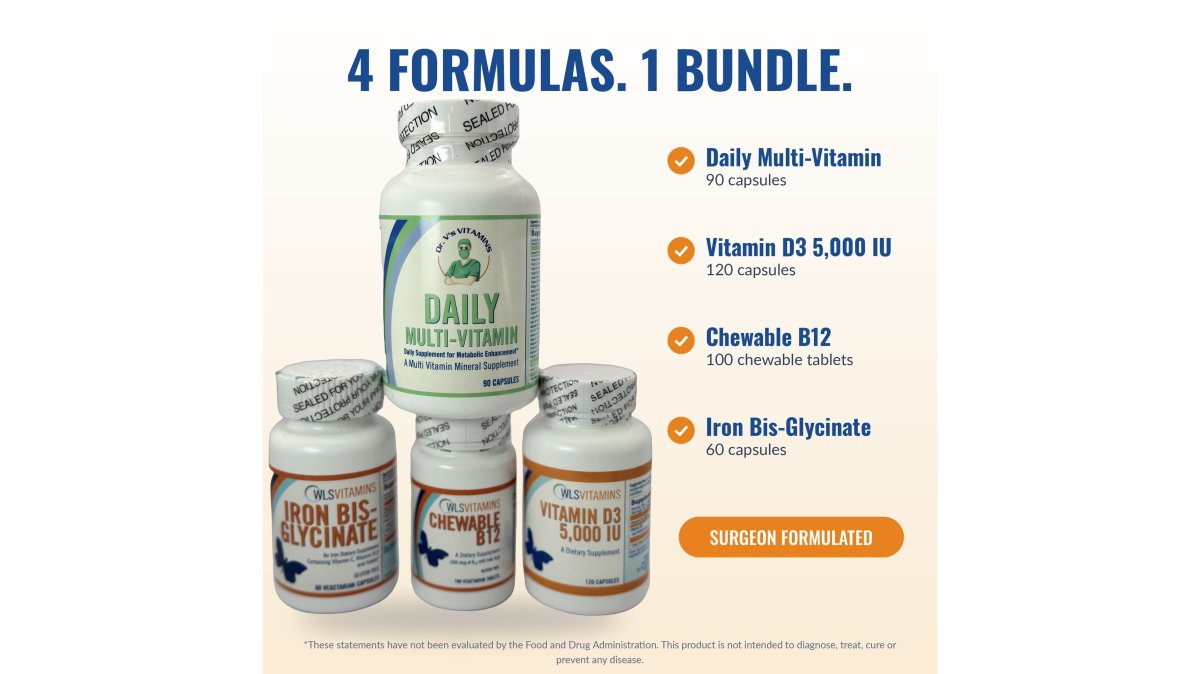
A bundle that covers these nutrients in one place can make a daily routine easier to follow. Our Dr. V's Bariatric Bundle brings together four products designed around these core needs, priced at $79.00. For a single daily multivitamin that covers the base nutrients, see our Bariatric Daily Multivitamin, priced at $25.00.


Best Vitamins for Gastric Sleeve Patients and How They Differ
Gastric sleeve patients have a smaller stomach but keep the full digestive path, so absorption changes are often smaller than after bypass. Even so, reduced intake can still lead to deficiencies, especially of iron, B12, and vitamin D.
How sleeve and bypass needs tend to differ:
- Both groups benefit from a multivitamin and labs checked on your care team's schedule.
Ask your surgeon or dietitian which products fit your procedure type.
Bariatric Vitamins vs. Regular Vitamins: Why the Formula Matters
A standard multivitamin from the drugstore is designed for a person with a normal digestive tract and a typical diet. After bariatric surgery, both of those assumptions change. The stomach may be smaller, acid production may be reduced, and the first part of the small intestine, where iron and calcium are primarily absorbed, may be bypassed. A bariatric-specific formula accounts for these changes in three ways: higher doses of critical nutrients, more absorbable forms, and delivery formats that are easier to tolerate.
How the formulas differ
- Dose: Bariatric multivitamins are formulated with higher amounts of key nutrients than general-purpose multivitamins, to account for reduced absorption.
- Form: Bariatric formulas favor forms that do not rely on stomach acid for absorption. Calcium citrate is preferred over calcium carbonate because it absorbs well even with reduced acid. Iron bisglycinate is often used because it is gentler on the stomach and less likely to cause constipation than iron sulfate. Methylcobalamin (a form of B12) and vitamin D3 (cholecalciferol) are also common in bariatric products.
- Format: Chewables, liquids, and small capsules are common because they are easier to swallow and digest after surgery. Some patients find that large tablets cause nausea or feel like they get stuck.
A label-evaluation checklist
When comparing bundles, look beyond the front label. Use this checklist to assess completeness and quality:
-
Serving size: Check how many capsules or chewables make up one serving. A product that requires six pills per day may be harder to adhere to than one that requires two.
-
Nutrient amounts: Compare the amounts of iron, calcium, vitamin D, B12, and thiamine against your provider's recommendations. Be aware that calcium is often sold separately because a full daily dose cannot fit into a multivitamin.
-
Nutrient forms: Look for forms such as calcium citrate, iron bisglycinate, methylcobalamin, and vitamin D3, and confirm the form on each label.
-
Procedure-specific design: Some bundles are formulated for gastric bypass (which may require higher iron and B12) and others for sleeve gastrectomy (which may need less aggressive doses). Check whether the product specifies which procedure it is designed for.
Read the label carefully to see what is included, including calcium, which may need to be taken separately.
Bundle vs. separate supplements
A bundle offers convenience and a coordinated routine, which can improve adherence. Separate products offer flexibility if your labs show you need a higher dose of a specific nutrient. Many patients use a bundle as a base and then add individual products as needed. The key is to review your regimen with your care team and adjust based on lab results, not marketing claims.
Liquid, Chewable, and Capsule Forms for Sensitive Stomachs
The right form depends on how well you tolerate pills. Chewable products are one option to discuss with your care team.
- Chewables do not require a large swallow.
Our Chewable B12 is one option for patients who prefer a chewable format, priced at $21.00.

Building a Daily Routine With a Bariatric Vitamin Bundle
A bundle only works if you actually take it consistently. The challenge is real: most bariatric routines involve multiple doses per day, and some nutrients compete with each other for absorption. A practical schedule that accounts for meals, doses, and separation rules makes the difference between a plan that looks good on paper and one you can sustain for years.
A sample timed schedule
Most practitioners recommend spreading supplements across the day rather than taking everything at once. Here is a common pattern that balances convenience with absorption:
- Morning (with breakfast): Take your bariatric multivitamin and any B12 supplement (chewable or sublingual). Food helps reduce nausea and improves tolerance for many people.
- Mid-morning or midday (at least 2 hours after calcium): Take iron. Iron absorbs best on an empty stomach, but if it causes stomach upset, take it with a small amount of food that does not contain calcium or high-fiber components.
- Afternoon or evening (with a meal): Take calcium citrate and vitamin D3. Calcium citrate is a form commonly chosen after surgery. Your care team can advise how to split your calcium dose.
Keep iron and calcium separated in your daily schedule, as your care team advises.
Making adherence sustainable
Pill burden is one of the most common reasons people fall off their supplement routine. A few practical strategies help:
- Use a weekly pill organizer with AM/PM compartments. Fill it every Sunday so you never have to think about doses during the week.
- Attach doses to existing habits. Take your morning multivitamin with your first cup of coffee or your breakfast plate. Take calcium with dinner. Habit stacking reduces reliance on memory.
- Set phone reminders for the midday iron dose, which is the easiest one to forget because it often falls outside meals.
- Keep a travel kit with a few days' worth of each supplement in your bag or car so you are not caught without them.
- Track missed doses for a week. If you notice a pattern (e.g., you always miss the midday dose), adjust the schedule rather than blaming yourself.
When to adjust your routine
Your needs change over time. Lab results may show that your iron is low despite consistent supplementation, or your provider may change your calcium dose after a bone density scan. Bring your supplement list to every follow-up visit and ask whether your current bundle still matches your labs. A routine that worked at six months post-op may need tweaking at two years.
Bundle vs. separate supplements: a balanced view
A bundle simplifies the routine because the products are designed to work together and the dosing is already coordinated. That convenience matters for adherence. However, separate products give you more flexibility if your labs call for a specific dose of one nutrient (for example, a higher iron dose) that a bundle does not provide. Many patients start with a bundle and then add or adjust individual products based on lab results. The best approach is the one you can follow consistently and that your care team can monitor effectively.
Start Your Bariatric Vitamin Plan With Dr. V's Bundle
Choosing a bariatric vitamin bundle is about matching nutrients, forms, and a routine to your procedure and your labs.
If you want a complete starting point, our Dr. V's Bariatric Bundle includes four products built around the nutrients bariatric and GLP-1 patients most often need. It is priced at $79.00.
Frequently Asked Questions
Do I need supplements for life after bariatric surgery? Most bariatric patients take supplements long term because absorption and intake stay changed after surgery.
Is a bundle better than buying supplements separately? A bundle can simplify a daily routine and cover core nutrients together.
Can I take bariatric vitamins if I use GLP-1 medication? GLP-1 medication can reduce food intake, so nutrient gaps are worth discussing with your clinician.
Frequently Asked Questions
What do bariatric vitamins do for your body?
Bariatric vitamins replace nutrients that your body may not absorb well after weight loss surgery or while taking GLP-1 medications. Common targets include iron, vitamin B12, vitamin D, calcium, thiamin and other B vitamins, which support red blood cell production, nerve function, bone health and energy. Bariatric multivitamins are designed around the reduced intake and altered digestion these patients experience. Your clinician can tell you which levels to monitor with blood tests.
Do I have to take bariatric vitamins forever?
Most bariatric programs recommend lifelong supplementation because absorption changes from surgery do not reverse over time. Daily intake usually continues indefinitely, with doses adjusted based on follow-up blood work, diet and any new symptoms. Stopping supplements without guidance can lead to deficiencies that appear months or years later, so review your plan with your bariatric team before changing anything.
What is the difference between a bariatric multivitamin and a regular multivitamin?
A bariatric multivitamin typically contains higher amounts of thiamin, iron, vitamin D and vitamin B12, and it is often easier to swallow or chew than a standard tablet. Regular multivitamins are designed for the general population. Your clinician can advise which products fit your situation after surgery. Check labels for the specific nutrients and amounts rather than relying on the word bariatric alone.
How should I choose a bariatric vitamin bundle?
Start by reviewing your procedure type, your recent lab results and your clinician's recommendations. Then read the label to confirm the bundle includes a complete multivitamin, iron, calcium with vitamin D, and vitamin B12, along with the forms and amounts your team advises. Consider how many pills you must take daily and whether chewable or liquid options fit your tolerance. Dr. V's Bariatric Bundle, priced at $79.00, combines four products covering these core nutrients.
Bariatric product prices
