
Table of Contents
- Why Bariatric Multivitamin Form Matters More Than You Think
- Capsules vs Chewables: Key Differences in Absorption and Nutrient Delivery
- When to Switch from Chewable to Capsule Vitamins After Bariatric Surgery
- Bariatric Vitamin Absorption: What Happens Inside Your Body
- Iron and Other Critical Nutrients: Choosing a Bariatric Multivitamin with Iron
- Taste, Texture, and Daily Serving Size: Practical Considerations
- Common Mistakes When Choosing Between Capsules and Chewables
- Conclusion
- Frequently Asked Questions
Last Updated: October 8, 2026
Why Bariatric Multivitamin Form Matters More Than You Think
After bariatric surgery, your body fundamentally changes how it absorbs nutrients. The difference between bariatric multivitamin capsules chewables isn't just convenience, it directly affects whether your body gets what it needs to prevent deficiencies, brain fog, and fatigue.
The real problem most guides skip: your bariatric multivitamin capsules and chewables don't work the same way inside a post-op body. A standard capsule designed for a normal stomach behaves completely differently in a pouch the size of an egg, and so do chewables. Understanding this distinction changes everything about which form serves you.
We'll walk you through how each form dissolves, absorbs, and delivers nutrients, and when switching makes sense for your recovery stage.
Capsules vs Chewables: Key Differences in Absorption and Nutrient Delivery
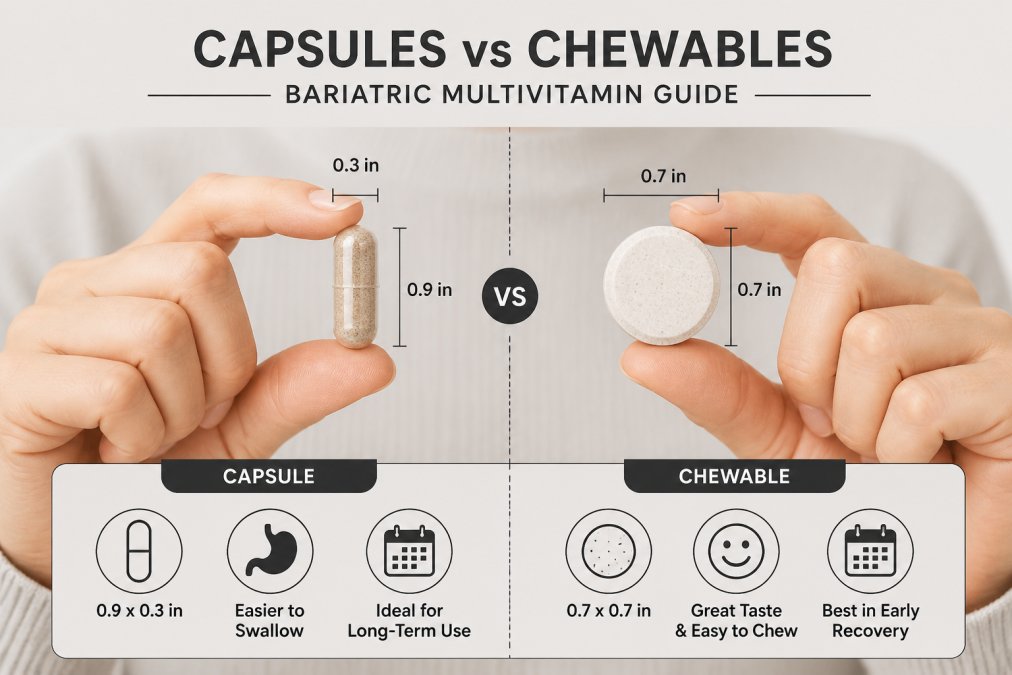
The choice between bariatric multivitamin capsules and chewables comes down to one core difference: how quickly and completely your reduced stomach can process them.
How Capsules Dissolve and Absorb
Capsules are designed to survive stomach acid long enough to reach your small intestine, where most nutrient absorption happens. After bariatric surgery, this matters more than ever.
When you swallow a capsule, it travels down your esophagus intact. In your pouch, stomach acid begins breaking down the gelatin shell, typically over 20-30 minutes. Once the shell dissolves, the powder releases gradually as it moves through your digestive tract.
The advantage: nutrient distribution spreads across a longer window, which can improve absorption in a system already struggling with nutrient uptake. The disadvantage: if your post-op stomach is sensitive or you have delayed gastric emptying, a capsule sitting in your pouch too long can trigger nausea.
WLSVitamins formulates our bariatric multivitamin capsules to reduce pouch time and minimize nausea risk for sensitive post-op patients.
How Chewables Break Down in Your System
Chewables work differently from the moment they hit your mouth, breaking down mechanically before they reach your stomach.
Chewing fragments a tablet into smaller pieces, so your pouch does less work. The fragments dissolve faster in stomach acid, usually within 10-15 minutes, and move into your small intestine more quickly.
The advantage: faster nutrient availability and less time in your sensitive post-op stomach. The disadvantage: because the nutrient load hits faster, some people experience mild GI distress. Chewables also contain binders and fillers, so you swallow more inactive ingredients.
When to Switch from Chewable to Capsule Vitamins After Bariatric Surgery
When to switch from chewable to capsule vitamins after bariatric surgery depends on your recovery stage and tolerance.
Immediately post-op (weeks 1-4): Stick with chewables or liquids. Your pouch is inflamed and swallowing is uncomfortable. Chewables bypass the need to swallow a large capsule and dissolve quickly, minimizing irritation.
Early recovery (weeks 4-12): Many patients can transition to capsules now. Swelling has reduced and your pouch is more tolerant. If chewables make you nauseous, a bariatric-specific capsule often helps. If chewables work fine, there's no medical reason to switch.
Long-term (3+ months post-op): Your choice becomes about preference and tolerance. Some find capsules easier long-term because they require less chewing and fewer pills per dose. Others prefer chewables because it's easier to verify you've swallowed them, which matters for compliance.
The mistake most patients make: assuming they should eventually graduate to capsules because capsules sound "more serious" or "more complete." That's not how it works. If chewables work for you, there's no advantage to switching. Stick with what your body tolerates.
Bariatric Vitamin Absorption: What Happens Inside Your Body
Bariatric vitamin absorption is fundamentally different from normal absorption because your surgery bypassed or reduced the part of your digestive system designed to absorb nutrients.
In a standard stomach, food spends 2-4 hours being broken down by acid and enzymes, and nutrients are absorbed throughout your small intestine. After bariatric surgery, food moves through much faster, sometimes in under an hour. Your pouch is smaller, your small intestine is shorter in bypass procedures, and your body has less time to extract what it needs.
This is why bariatric multivitamin capsules chewables must be formulated differently than regular vitamins. A standard multivitamin assumes normal transit time and stomach acid production, so it won't work for you.
A bariatric-specific formula delivers nutrients in forms your compromised system can absorb: iron in a more bioavailable form, calcium as citrate rather than carbonate (your reduced stomach acid can't break down carbonate effectively), and higher-dose B vitamins because some loss is expected.
Many bariatric patients take multiple supplements, one multivitamin plus separate iron, calcium, and B12. This creates two problems: compliance and cost. A truly complete bariatric multivitamin should deliver meaningful amounts of iron, calcium, and B vitamins in a single daily or split dose.
Iron and Other Critical Nutrients: Choosing a Bariatric Multivitamin with Iron
Iron deficiency is one of the most common long-term complications after bariatric surgery. It develops slowly and quietly, often without obvious symptoms until you're severely deficient.
Iron is difficult for bariatric patients because absorption requires adequate stomach acid and healthy stomach lining, and your surgery removed or bypassed both. Standard iron supplements, especially ferrous sulfate, require an acidic environment to absorb, and your reduced stomach acid can't process it efficiently.
Bariatric Daily Multivitamin | Dr. V’s Vitamins →
A bariatric multivitamin with iron needs a more absorbable form. Ferrous citrate and ferrous bisglycinate require less stomach acid to absorb.
Dosage matters too. A standard multivitamin's 18 mg of iron is adequate for a normal stomach, but often insufficient for a bariatric patient because absorption is already compromised. Many bariatric-specific formulas include 18-27 mg to account for this loss.
Beyond iron, a complete bariatric multivitamin must address calcium, B12, and vitamin D, the nutrients bariatric patients are most likely to become deficient in. But calcium and iron compete for absorption, so taking them together reduces how much of each you absorb. The best formulas separate these nutrients into different doses or time them strategically.
Our Bariatric Daily Multivitamin at WLSVitamins includes 75 mg of Vitamin B1 (thiamine), which is critical for metabolism during rapid weight loss, plus comprehensive iron support in a form designed for reduced stomach acid.

Taste, Texture, and Daily Serving Size: Practical Considerations
After surgery, you'll take vitamins for life. Taste, texture, and daily pill count aren't minor details, they're the difference between consistent adherence and giving up after three months.
Taste: Chewables win for most people. They're flavored and actually taste like something. Capsules are flavorless, though some find the gelatin slightly unpleasant. If you're nauseous from surgery, a flavored chewable might settle your stomach rather than trigger more nausea.
Texture: This is personal. Some post-op patients can't stand the grittiness of chewables; others find capsules too large to swallow. The only way to know is to try.
Daily serving size: This is where most patients get frustrated. A "complete" bariatric multivitamin often requires 3-6 capsules or tablets daily, sometimes split morning and evening. If you're already struggling with nausea or swallowing, six pills daily becomes a real barrier to compliance.
The best bariatric multivitamin balances completeness with practicality, delivering adequate nutrients in a number of pills you can realistically take daily.
| Consideration | Capsules | Chewables |
|---|---|---|
| Taste | Flavorless | Flavored, pleasant |
| Swallowing difficulty | Larger size | Requires chewing |
| Nausea trigger | Less likely | Possible for some |
| Daily serving size | Usually 2-3 | Often 4-6 |
| Nutrient density | Higher per pill | Lower per tablet |
| Long-term adherence | Better for most | Better if taste matters |
Common Mistakes When Choosing Between Capsules and Chewables
The biggest mistake: assuming the form doesn't matter as long as you're taking something. It absolutely matters. Your post-op body processes capsules and chewables differently, and the wrong form can mean the difference between preventing deficiencies and developing them.
Mistake 1: Buying regular vitamins and cutting them in half. This doesn't work. Cut a capsule and the powder spills out; cut a tablet and the nutrients aren't evenly distributed. Bariatric-specific formulas are engineered for your needs, generic vitamins aren't.
Mistake 2: Choosing based on price alone. A cheaper multivitamin usually means fewer nutrients, lower-quality forms, or inadequate dosages for a post-op body.
Mistake 3: Taking capsules and chewables simultaneously. Some patients combine forms for "complete coverage," but this creates confusion about what you've taken and often leads to overdosing on some nutrients while remaining deficient in others. Pick one form and stick with it.
Mistake 4: Ignoring the nutrient forms listed on the label. A label that says "iron" doesn't tell you if it's ferrous sulfate (poorly absorbed after surgery) or ferrous citrate (better absorbed). Same with calcium: carbonate requires stomach acid, citrate doesn't. The form matters more than the amount.
Mistake 5: Assuming all bariatric formulas are the same. They're not. Some include iron, some don't. Some have adequate calcium, some have token amounts. Read what you're actually buying, not just the front-label marketing.
Conclusion
The choice between bariatric multivitamin capsules and chewables isn't about preference, it's about what your post-op body can absorb and tolerate. Capsules offer nutrient density; chewables offer ease of swallowing and faster dissolution. Neither is universally "better." The best choice is the one your body tolerates consistently, long-term.
The real challenge isn't picking a form, it's finding a formula engineered for bariatric patients, with adequate iron, calcium, and B vitamins in forms your compromised digestive system can absorb. At WLSVitamins, our Bariatric Daily Multivitamin is formulated by a bariatric surgeon using over two decades of patient blood work data. Each capsule is designed for rapid absorption in a post-op system, with the nutrient forms and dosages that actually prevent deficiencies. Start with our formula and see how your body responds.
The challenge after bariatric surgery isn't just taking vitamins, it's taking the right formula designed for how your body actually works now. WLSVitamins' Bariatric Daily Multivitamin includes high-dose B vitamins (including 75 mg of thiamine for metabolism support), comprehensive iron in an absorbable form, and complete micronutrient coverage in just 3 capsules daily. Get started with WLSVitamins and feel the difference a surgeon-formulated approach makes.
Frequently Asked Questions
Are capsules better than chewables for bariatric multivitamins?
Neither is universally better, it depends on your timing after surgery and personal tolerance. Capsules offer higher nutrient density and faster absorption once your digestive system can handle them, typically 4-6 weeks post-op. Chewables are gentler on sensitive stomachs immediately after surgery and ensure you absorb nutrients through saliva and partial digestion. The best bariatric multivitamin capsule or chewable is the one you'll actually take consistently.
When should I switch from chewables to capsules after bariatric surgery?
Most bariatric patients can transition to capsules 4-6 weeks after surgery, once nausea subsides and your pouch tolerates solid foods. However, if you have a sensitive stomach or experience discomfort with capsules, stay with chewables longer or alternate between forms. Always follow your surgeon's timeline. Start with one capsule daily to test tolerance before switching completely.
Do bariatric multivitamin capsules and chewables contain the same nutrients?
They can contain identical nutrient profiles, but serving sizes often differ. Capsules typically pack more nutrients into fewer pills due to their design, while chewables may require 4-6 tablets daily to match the same nutrient load. Check the label's serving size and daily dose, a complete bariatric multivitamin with iron should include high-dose B vitamins (especially B12), iron, calcium, and vitamin D, regardless of form.
How does bariatric vitamin absorption differ from regular vitamin absorption?
After bariatric surgery, your reduced stomach size and altered digestive tract limit how much nutrient your body can absorb at once. This is why bariatric multivitamins are formulated with higher concentrations and better bioavailability than standard vitamins. Capsules dissolve quickly in stomach acid and bypass some of the absorption challenges chewables face. However, both forms work well if formulated specifically for bariatric patients, the key is consistent, high-quality supplementation matched to your procedure type.